
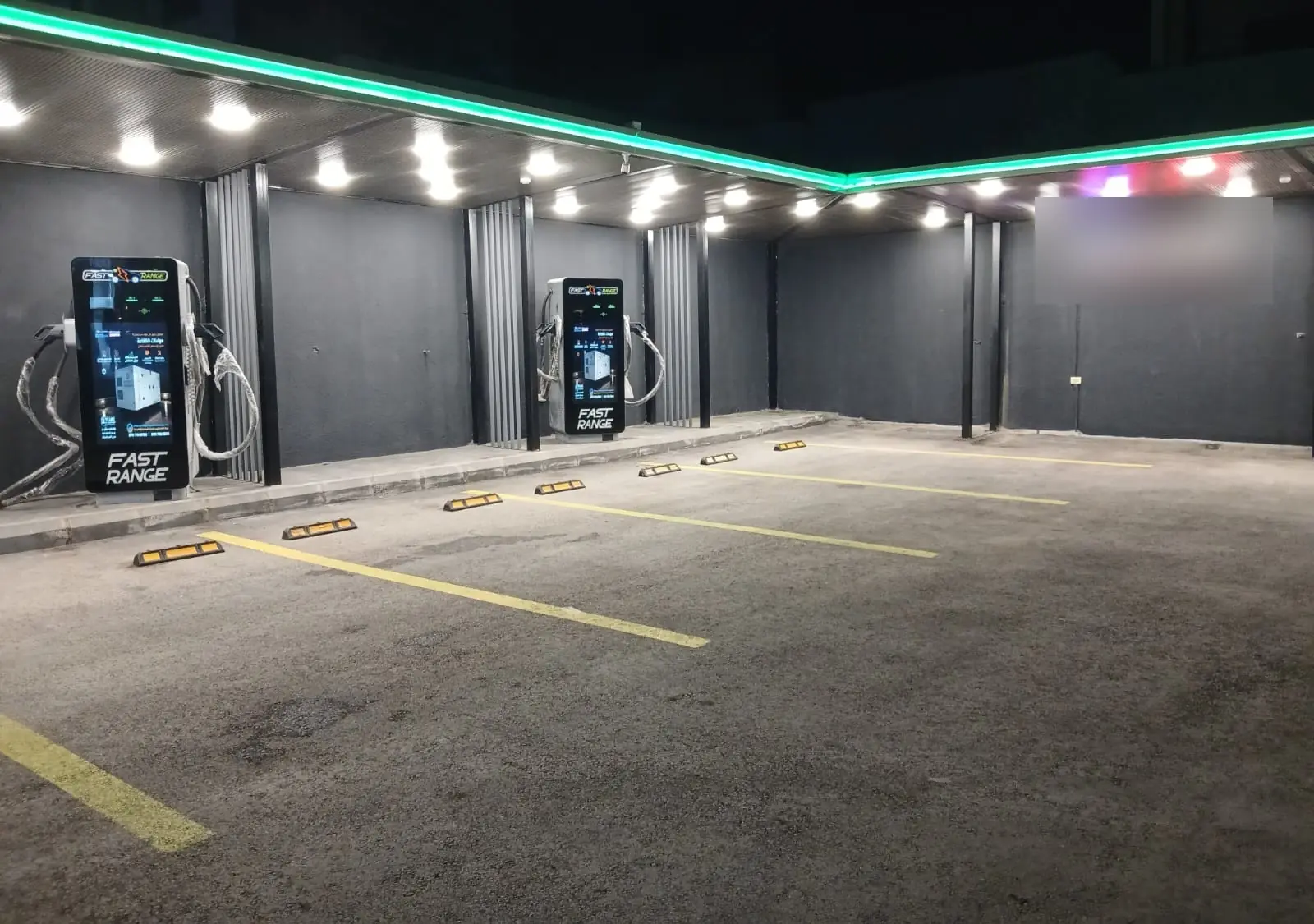
How is the cost of a charge worked out?
Cost = energy charged (kWh) × price per kWh
A kilowatt-hour (kWh) is a unit of energy, like a litre of petrol. The charger measures exactly how much energy it gives your car, and the figure appears on the screen during the charge and at the end.
Our prices
At FAST RANGE the price changes with the time of day and is shown on an electronic board at the station. We believe you should know the price before you start charging, not get a surprise at the end.
| Time band | Price per kWh |
|---|---|
| Awaiting confirmation: price per kWh by time band | |
If your schedule is flexible, charging in the cheaper band lowers the cost with no difference in charging speed or quality.
Calculate the cost of your charge
Enter your battery capacity, the charge range and the price per kWh to see the approximate cost.
Enter the price per kWh to see the cost.
The figure is approximate. A small part of the energy is lost as heat while charging, and the actual cost is what the charger measures and shows on its screen.
What does each 100 km cost?
Most electric cars use roughly 14 to 20 kilowatt-hours per 100 km, depending on the size of the car, driving speed and use of the air conditioning. A small car in town is closer to the lower figure, and a large car on the motorway in summer is closer to the higher one.
Cost per 100 km = consumption per 100 km × price per kWh
For example, a car that uses 16 kWh per 100 km needs 16 times the price per kWh to cover 100 km.
Check your car's consumption on its trip screen. It is more accurate than any general figure.
Public charging versus charging at home
Charging at home goes on your household electricity bill, and it is convenient if you have a private parking space and charge overnight. But it is slow, and many apartment residents cannot do it. Fast charging at a station gives you hours of driving in minutes, and you pay for the speed and availability. Most owners use both, depending on their day.
Tips to lower your charging cost
- Charge in the cheapest band on the price board if you can.
- Stop at 80%: charging after that is slower, so you spend the same time for less energy.
- Keep your tyres at the right pressure and use the air conditioning in moderation, as both change consumption noticeably.
- Look out for the FAST RANGE app when it launches, as it collects points on every charge.
Frequently asked questions
What is the price per kWh at FAST RANGE?
The price changes by time band through the day and is shown on the price board at the station. Current prices: Awaiting confirmation: price per kWh by time band
How much does a full charge cost for an electric car?
Multiply the energy you need by the price per kWh. For example, charging a 60 kWh battery from 20% to 80% needs about 36 kWh, so the cost is 36 times the price per kWh in the band you charge in.
Do I pay for time or for energy?
We charge for energy in kilowatt-hours, as measured by the charger.
Why is the evening price different from the morning?
Because the cost of electricity itself changes with the time of use during the day, and that is reflected in the charging tariff. The details for each band are on the price board at the station.