
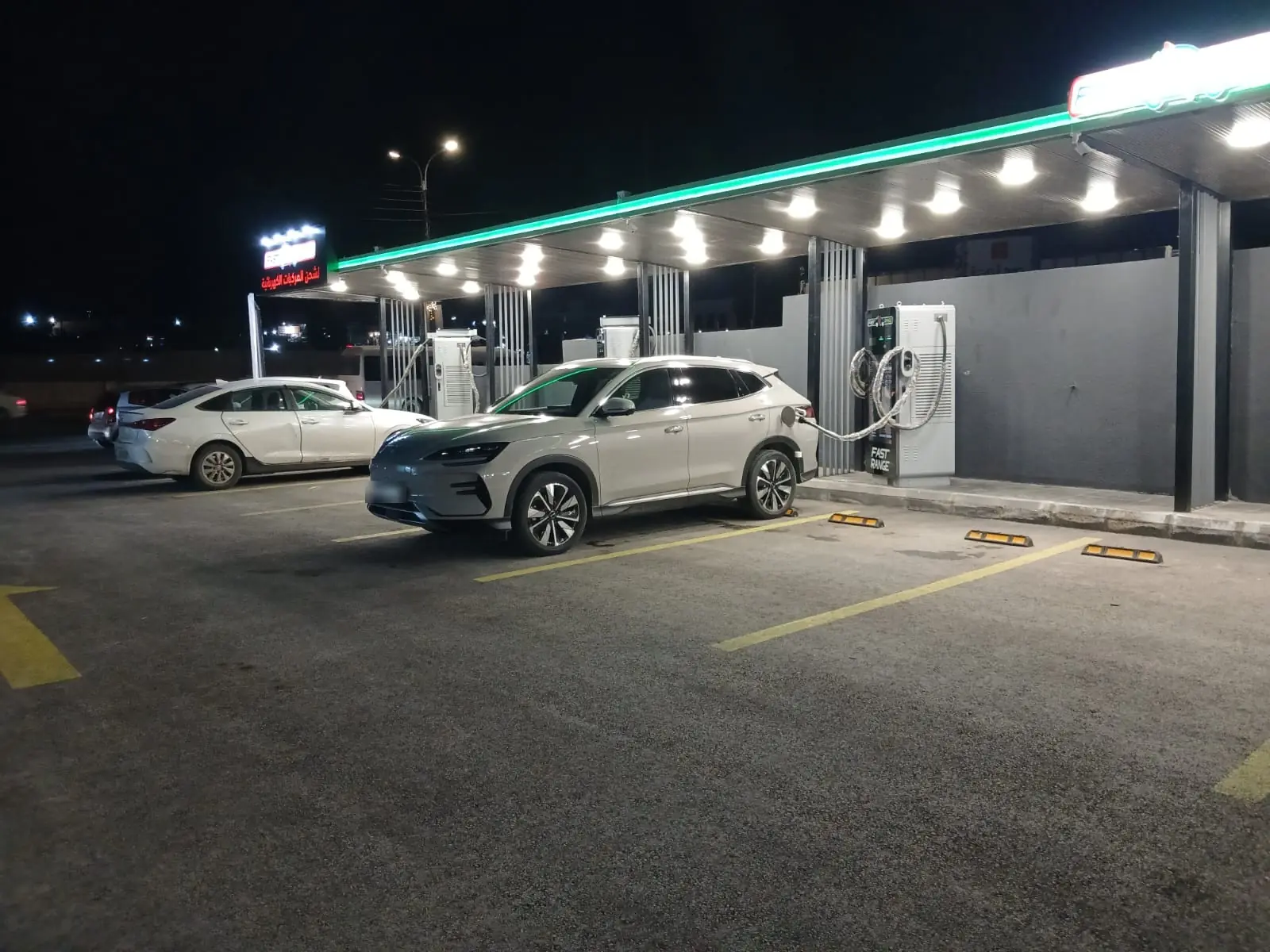
The short answer
Charging time depends on three things: how much energy the battery needs, the highest power your car can accept, and the state of the battery when you plug in (its temperature and charge level). On a DC fast charger, most modern cars need between 20 and 45 minutes to go from 20% to 80%. On a normal home charger, the same charge takes several hours.
Work out the time for your car
The rough formula is simple:
Minutes ≈ (battery capacity × share of charge needed) ÷ average power × 60
Battery capacity is in kilowatt-hours (kWh), and power is in kilowatts (kW).
Example: a 60 kWh battery charged from 20% to 80% needs 60% of its capacity, which is 36 kWh. If the average power your car accepts is 60 kW, it takes about 36 minutes.
Note the word average. The power you see on the screen in the first minutes is the peak. It then drops gradually as the battery fills, so the average is lower than the top figure the manufacturer advertises.
Rough worked examples
These are calculations for illustration, not measurements of specific cars at our station:
| Battery capacity | Energy from 20% to 80% | Average power | Approximate time |
|---|---|---|---|
| 40 kWh | 24 kWh | 40 kW | about 36 minutes |
| 60 kWh | 36 kWh | 60 kW | about 36 minutes |
| 60 kWh | 36 kWh | 100 kW | about 22 minutes |
| 80 kWh | 48 kWh | 100 kW | about 29 minutes |
Why does charging slow down after 80%?
A battery is like a hall filling with people: getting in is quick when it is empty and slower as it fills. Your car's battery management system lowers the power automatically after about 80% to protect the cells from heat and strain. That is why charging from 80% to 100% can take almost as long as the whole charge from 20% to 80%.
The practical advice: on a fast charger, charge to 80% if that covers your trip, and leave 100% for the home charger or for long journeys.
What makes your charge slower or faster?
- The maximum power your car accepts: the charger never gives a car more than it can take. A small car that accepts 40 kW will charge at about the same speed on a 60 kW charger or a bigger one.
- Battery temperature: a cold battery on a winter morning accepts less power. A very hot battery after fast summer driving may also have its power reduced to protect it.
- Charge level when you arrive: the emptier the battery when you arrive, the faster the first minutes.
- Power sharing: on some two-cable chargers, power is split between two cars when both charge at once.
- The charger's maximum power: maximum power at our station: Awaiting confirmation: maximum charging power (kW).
Fast charging versus charging at home
A home charger uses alternating current (AC), and a common rating is about 7 kW, which adds roughly 7 kWh per hour. A 60 kWh battery needs about 5 hours on it to go from 20% to 80%. That suits overnight charging, but when you need the car within the hour, a fast charger is the answer. To learn how regular fast charging affects the battery, read does fast charging damage the battery.
Frequently asked questions
How many minutes does an electric car need on a fast charger?
In many modern cars, about 30 minutes from 20% to 80%. Cars that accept low power may need 45 minutes or more, and newer high-power cars may need less than 25 minutes.
Why does my car not reach the maximum power shown on the charger?
Because the car decides how much power it takes. If your car's maximum is lower than the charger's, it charges at its own maximum. Power also drops with a cold or very hot battery, and as the charge approaches 80%.
Is charging from 0% to 100% better?
Not for your time. Charging from 80% to 100% is slow, so on a fast charger it is better to stop at 80% if that is enough.
How long does a car take on a home charger?
On a 7 kW home charger, a 60 kWh battery needs about 5 hours from 20% to 80%, and longer on a regular wall socket.