
How does home charging work?
Home charging is AC charging. Electricity comes from the grid to the car, and the on-board charger inside the car converts it to direct current and stores it in the battery. So the charging speed is limited by the lowest of three things: the rating of the socket or wallbox, the capacity of your home's wiring, and the power of your car's on-board charger. The difference between the two kinds of charging is explained in AC vs DC charging.
Option one: the portable cable
A cable that comes with many cars, or is sold separately, with a small control box in the middle. One end plugs into a regular wall socket and the other into the car's charging inlet. Its power is low, usually somewhere between 2 and 3 kW depending on the cable and the socket.
A worked example: at about 2 kW, with consumption of 15 kWh per 100 km, each hour of charging adds roughly 13 km of range. That is enough for someone who drives a short distance each day and leaves the car plugged in overnight, but not for someone who drives long distances.
Be careful: a portable cable draws a steady current for many hours, which is a real test for the socket and the wiring. Use a sound socket dedicated to the job, never use extension leads or multi-plug adapters, and feel the socket and plug after the first hour. If either is clearly hot, stop charging and talk to an electrician.
Option two: the wallbox
A fixed unit mounted on the wall on its own dedicated circuit. In homes with a single-phase supply the common rating is about 7 kW; with a three-phase supply it can be 11 kW or more, if your car accepts it. A wallbox is faster, safer for daily use because it is designed for that load, and some models let you schedule charging from an app.
Check the inlet type
Cars built for the Chinese market usually have a GB/T AC inlet, while European and Korean cars have a Type 2 inlet. The wallbox or cable must match your car's inlet. Do not rely on cheap adapters of unknown origin for everyday charging. Read the EV charger types guide.
What a licensed electrician checks
Installing a wallbox is electrical work and should be done by a licensed electrician. These are the main points they usually check:
- Your home's supply capacity: whether the supply and the main breaker can handle the charger alongside everything else, especially air conditioners and water heaters.
- A dedicated circuit: a cable of the right size and a breaker for the charger alone.
- Protection: a suitable residual current device and proper earthing.
- Location: a wall close to the car's charging inlet, protected from rain and direct sun where possible, so the cable reaches without strain.
- Local requirements: if your electricity distribution company or building management has specific requirements, ask about them before installing.
How long does charging at home take?
Rough worked examples for a car with a 60 kWh battery charging from 20% to 80%, which is about 36 kWh. Losses add a little time:
| Charging method | Approximate power | Approximate time |
|---|---|---|
| Portable cable in a regular socket | About 2 kW | About 18 hours |
| Single-phase wallbox | About 7 kW | About 5 hours |
| Three-phase wallbox | About 11 kW | About 3.5 hours |
| DC fast charger | Depends on the car and charger | About 30 minutes in many modern cars |
These are worked examples for illustration, not measurements of particular cars. Details in how long it takes to charge an electric car.
When you still need fast charging
- Long trips: to Aqaba or the Dead Sea, for example. Read EV road trips from Zarqa.
- When you forget to plug in: or when you need the car within the hour, not by tomorrow.
- High daily mileage: ride-hailing drivers and people who travel between cities a lot.
- When you have no private parking: many apartment residents cannot install a charger at all.
Tips for charging at home
- Set the charge limit in the car to the manufacturer's recommendation, usually 80% for daily use, unless you have an LFP battery and the manufacturer advises otherwise.
- Use scheduled charging if your car or wallbox has it, so the session finishes shortly before you leave.
- Check the cable and plug from time to time, and never use a damaged cable.
- In summer, cool the cabin while the car is plugged in. Read charging in summer and winter.
When you need a quick charge in Zarqa
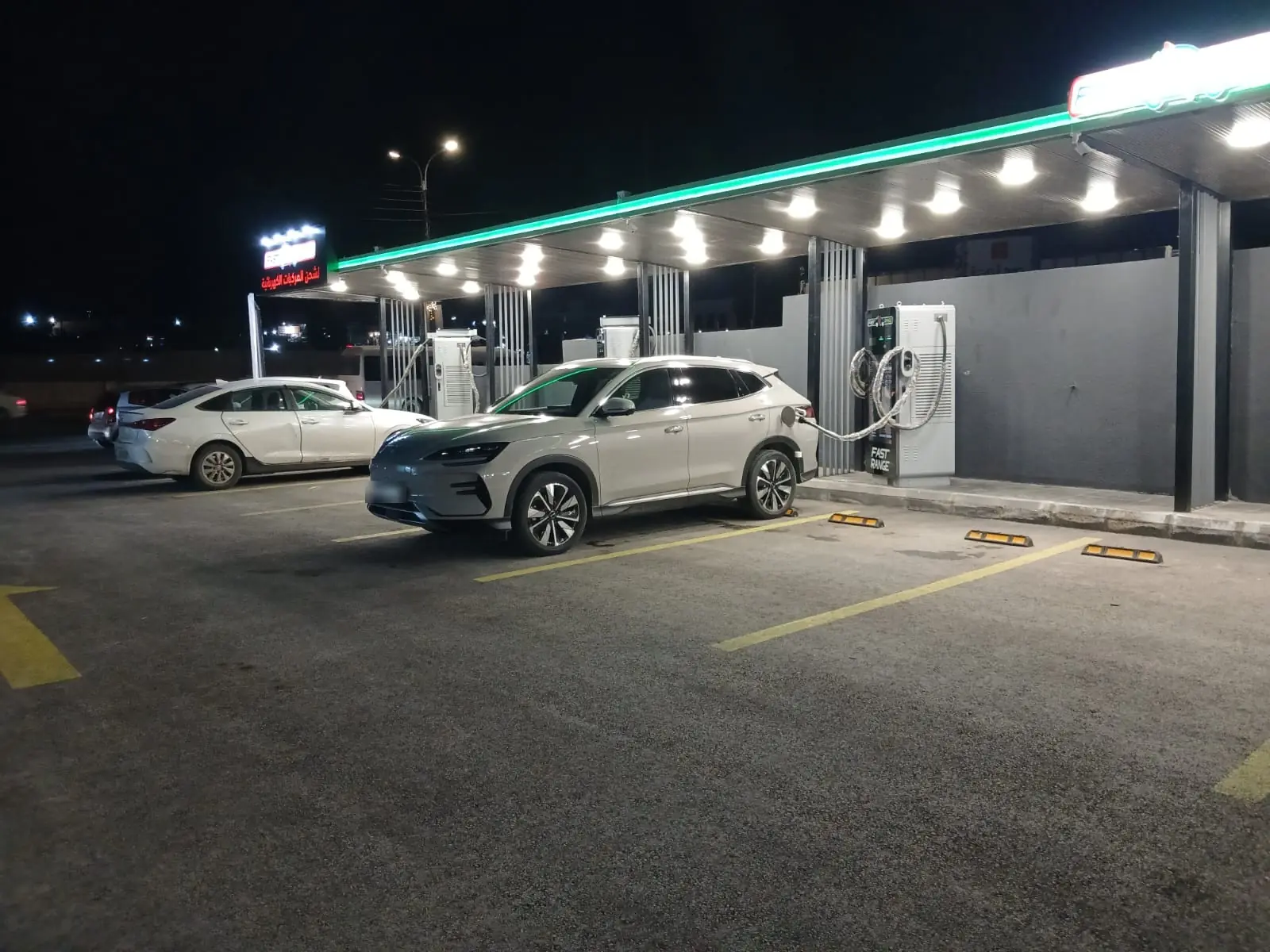
Home charging covers most days, and stations cover the rest. FAST RANGE is on Army Street in Zarqa, opposite Prince Hashem Military Hospital, near the old Zarqa bus complex and the Civil Status Department. Station details are on the EV charging in Zarqa page.
Frequently asked questions
Can you charge an electric car from your home supply?
Yes, with a portable cable in a suitable socket or with a wallbox on a dedicated circuit. A wallbox is faster and better suited to daily use, and it should be installed by a licensed electrician.
How long does an electric car take to charge at home?
It depends on the power. A 60 kWh battery needs about 5 hours from 20% to 80% on a 7 kW wallbox, and more than a full night on a portable cable at about 2 kW. These are rough worked figures.
Do I need an electrician to install a home EV charger?
Yes. A licensed electrician checks your home's supply capacity and installs a dedicated circuit with the right cable, its own breaker, residual current protection and proper earthing.
What is the difference between a portable cable and a wallbox?
A portable cable plugs into a regular socket and has low power, usually between 2 and 3 kW. A wallbox is fixed on a dedicated circuit with more power, often about 7 kW in single-phase homes, and is safer for daily use.
Is a home charger different for Chinese cars?
Cars built for the Chinese market usually have a GB/T AC inlet, while European and Korean cars have a Type 2 inlet. Choose a wallbox or cable that matches your car's inlet.