
The short answer
Most current electric cars advertise somewhere between about 300 and 600 km or more, depending on battery size and test standard. On the road, real range is usually lower than the advertised figure, especially on the motorway in summer. The best way to know your car's range is to work it out from its actual consumption:
Approximate range (km) ≈ usable battery capacity (kWh) ÷ consumption (kWh per 100 km) × 100
Example: a 60 kWh usable battery at 16 kWh per 100 km gives about 375 km. If consumption rises to 20 kWh per 100 km on a hot day on the motorway, range falls to about 300 km. You will find your real consumption on the car's trip screen.
CLTC vs WLTP: why the advertised number varies
Advertised range comes from a laboratory test to a set standard, and each market has its own:
- CLTC: the Chinese standard, with fairly low average speeds, so it usually produces the highest figures. Most adverts for cars imported from China use it.
- WLTP: the European standard, with higher speeds, so it usually gives a lower figure for the same car.
- NEDC: an older standard you still see in adverts for older cars, and its figures are optimistic too.
An example from a car that is common in Jordan: CarNewsChina's database lists 605 km CLTC for the BYD Song Plus EV with an 87 kWh battery, while BYD's European website lists up to 500 km WLTP for its European sibling, the Seal U, with an 87 kWh battery. The two cars are not identical, but the gap shows the effect of the standard. So always compare figures measured to the same standard.
Advertised range vs real range
Even a WLTP figure is a lab number. For example, EV Database lists 572 km WLTP for the latest rear-wheel-drive Tesla Model 3, and estimates its real-world range in mild weather at about 675 km in the city and about 445 km on the motorway. Notice that the motorway figure is the lowest, the opposite of what petrol drivers are used to: an EV benefits from regenerative braking in town and loses out to air resistance at speed.
What reduces range in Jordan?
- Motorway speed: air resistance climbs steeply with speed, so driving at 120 km/h uses noticeably more than 100 km/h.
- Air conditioning in summer: its effect is most visible in traffic and slow driving.
- Cold in winter: heating uses energy, and a cold battery is less efficient. Read charging in summer and winter.
- Hills: Amman's steep roads, the drive back up from the Dead Sea and parts of the Desert Highway take a lot of extra energy.
- Load and wind: a car full of passengers and luggage, or a headwind on the Desert Highway, raises consumption.
- Tyres: low pressure and very wide tyres increase consumption.
Climbs and descents
On the way down, regenerative braking recovers part of the energy spent climbing, but not all of it. So a round trip between two places at different heights uses more than a flat route of the same length. The clearest example in Jordan is the Dead Sea road, explained in EV road trips from Zarqa.
How to read the range figure on your screen
The remaining range on the screen is an estimate the car calculates from your consumption over the last stretch of driving. After gentle city driving it can look generous, then fall quickly once you join the motorway. It is more reliable to watch the percentage and your consumption in kWh per 100 km, always keep a margin, and plan to arrive at a charger with roughly 10% to 20% left.
Tips for more range
- Ease off a little on the motorway; you gain more range than you lose in time.
- Use the eco driving mode and a stronger regenerative braking setting in town.
- Cool or warm the cabin while the car is still plugged in before you leave.
- Keep tyres at the recommended pressure and remove unnecessary weight.
For figures on specific cars, read BYD Seagull charging, BYD Song Plus charging and Tesla Model 3 charging.
Start your trip with a charged battery
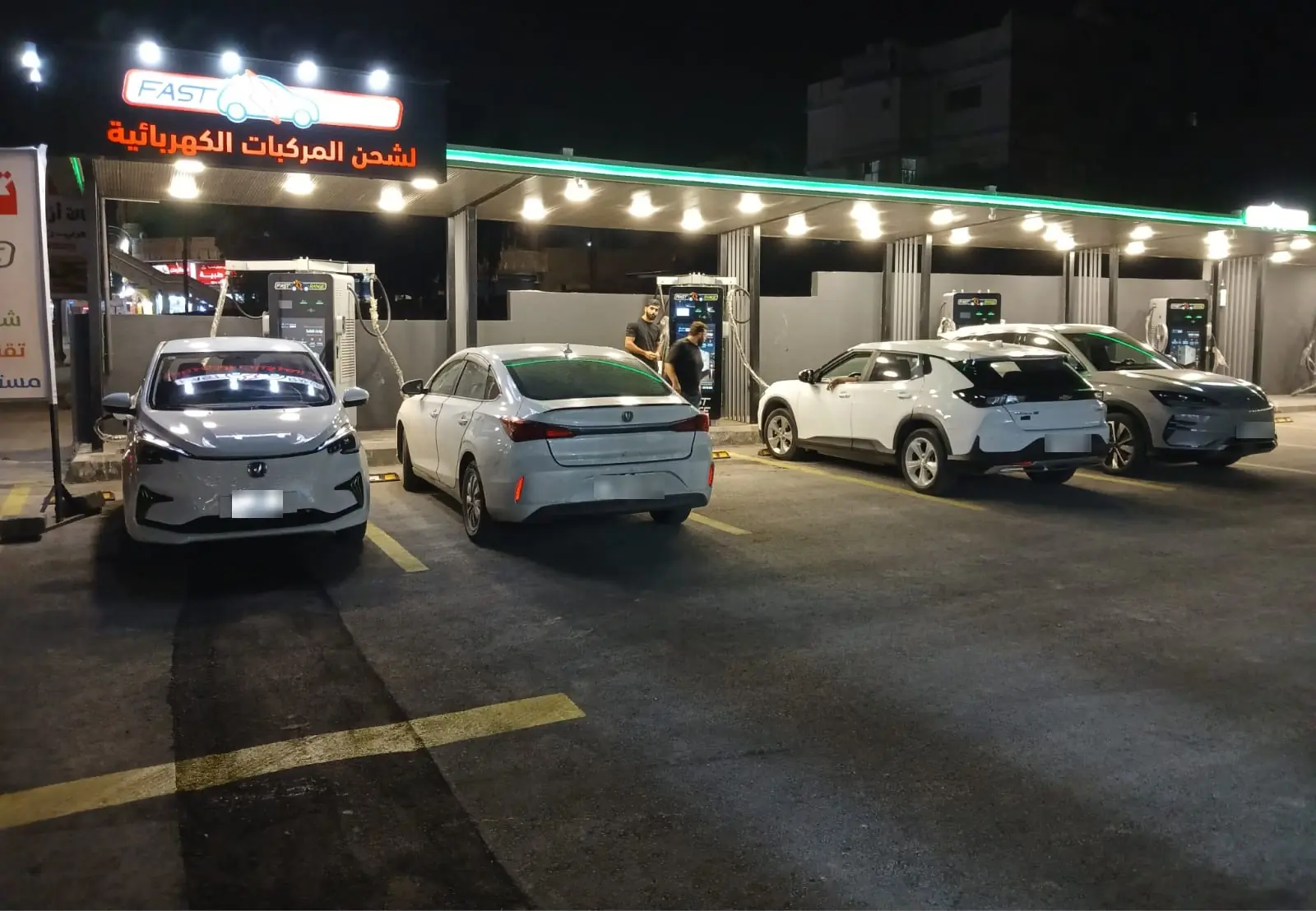
The easiest way to stop worrying about range is to start a long drive with a charged battery. FAST RANGE is on Army Street in Zarqa, opposite Prince Hashem Military Hospital, near the old Zarqa bus complex and the Civil Status Department.
Frequently asked questions
How far can an electric car go on one charge?
It depends on the car. Most current models advertise roughly 300 to 600 km or more, and real range is usually lower, especially on the motorway in summer. Work it out by dividing usable battery capacity by your car's consumption per 100 km.
What is the difference between CLTC and WLTP?
CLTC is a Chinese standard with low average speeds, so it gives higher figures. WLTP is a European standard with higher speeds, so it usually gives a lower figure for the same car. Always compare figures measured to the same standard.
Does air conditioning reduce an EV's range?
Yes, it takes some of the battery's energy, and the effect is most noticeable in slow city driving. How much depends on the car and the temperature.
Why does my EV go less far on the motorway?
Because air resistance rises steeply with speed, and regenerative braking has few chances to recover energy. Slowing down a little noticeably extends range.
How far does a BYD Seagull go on one charge?
CarNewsChina's database lists 305 km for the smaller battery and 405 km for the larger one on the CLTC standard for the 2025 model. Real range is usually lower, especially on the motorway.